
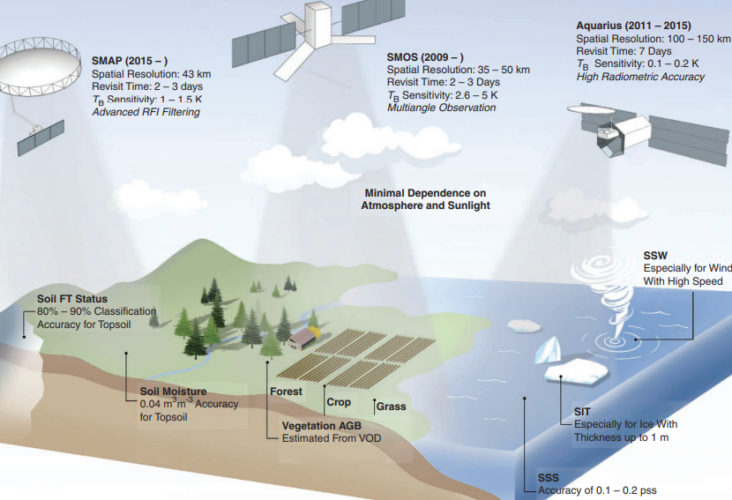
Above : Illustration of L-band microwave radiometry satellites (SMOS, SMAP, Aquarius) used to monitor the ECVs discussed in the newly published article
From Yiwen Zhou : A new paper synthesizes how L-band satellite radiometry enables robust, global, all-weather observations of Essential Climate Variables, such as soil moisture, vegetation above ground biomass, sea surface salinity and cryosphere dynamics.
This work reflects a truly international effort across Europe and the USA, bringing together over 30 top-notch scientists from the SMOS, Aquarius, and SMAP missions. Led by the scientists from WSL (Switzerland) and CESBIO (France), the paper underscores the strength of long-standing collaboration in advancing passive microwave remote sensing for improved understanding of global hydrological and carbon cycles.
From this perspective, one can see that L band radiometry is now a proven key element of the “remote sensing toolbox” as it enables to monitor crucial components of our climate evolution. Since the inception of these unique measurements with SMOS in 2009, the progresses made pave the way to improved algorithms and retrieval approaches for applications over complex landscapes. They enhance the spatial resolution and expand capacbilities to other low requencies, e.g., P-band, through next-generation satellites inspired by the SMOS mission.
More details : here !