
Passive microwave radiometers, such as SMOS, measure the Earth’s natural microwave emissions. As this radiation travels upwards, the soil emission is attenuated by the forest canopy (which also emits). At L-band, this effect is characterised by the Vegetation Optical Depth (LVOD), a metric increasingly used to estimate global forest biomass as it is related to it.
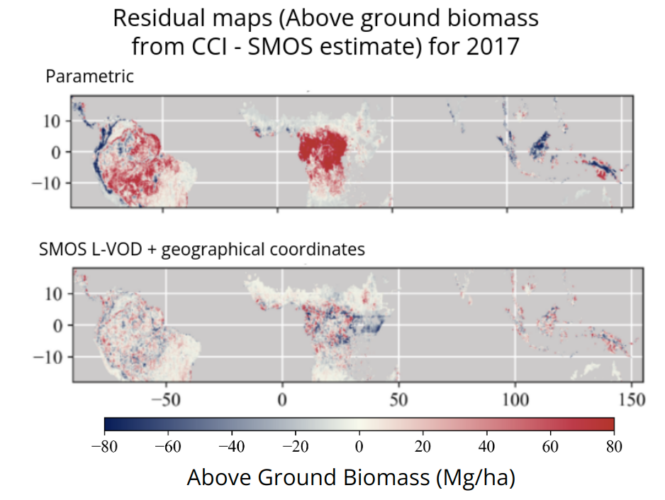
However, using LVOD as a direct proxy for biomass has limitations: it can saturates in dense forests and is highly sensitive to the plants’ water content. A new study reveals that the relationship between LVOD and biomass is not universal; rather, it is highly dependent on local ecological contexts. Because standard methods ignore this spatial dependency, they often underestimate biomass in dense forests, capping out near 300 Mg/ha ! As recently demonstrated by J.C. Salazar Neira, by incorporating geospatial context (like ecoregions or geographic coordinates) as a proxy for unobserved ecological variations, this new approach significantly reduces uncertainty. This location-aware method maintains accuracy up to 400 Mg/ha and stabilises long-term carbon stock estimates, cutting unrealistic yearly fluctuations by a factor of 2.6 while preserving key trends.
More info : on the newly published letter !